Neutrl's synthetic dollar delivers premium market-neutral yields by harnessing exclusive OTC market strategies.
By setting new standards in stability and transparency, Neutrl brings the next evolution in crypto-native yields, making private strategies accessible for everyone.
Security
Risk-Minimized Architecture
Independent Verification
Core smart contracts and major upgrades are reviewed by independent security experts prior to deployment, with all updates undergoing external audits to uphold the highest security standards.
Onchain activity and integrations are continuously monitored using industry-leading advanced threat detection systems. Abnormal behavior is proactively identified and routed through clearly defined escalation paths to ensure rapid response and operational oversight.
Custody & Key Management
Custody and settlement conducted through institutional-grade custodians, with operational keys and sensitive actions governed by policy-based approvals, strict access controls, and comprehensive audit trails aligned with institutional best practices.
Protocol Controls
Risk controls are designed to limit impact through predefined caps, automated guardrails, and clearly scoped emergency actions, all of which are intentional, auditable, and subject to formal oversight.
Infrastructure Security
Security extends beyond code to operational practices. APIs, deployments, secrets, and access management are subject to regular reviews, independent assessments, and ongoing testing to ensure controls remain effective through industry-leading security researchers.
Security partners are disclosed for transparency. Coverage may vary by product and over time.
Our Products
Stable, Transferable, Yield-Generating
NUSD. Designed for Capital Efficiency.
NUSD is an institutional-grade, DeFi composable synthetic dollar backed by delta-neutral strategies and other crypto assets.
Deposit or swap supported stablecoins for NUSD to enter the Neutrl system.
Stay fully liquid while preparing to earn yield through staking.
2 | Stake
Stake NUSD to mint sNUSD and activate liquid yield.
Your balance begins accruing yield immediately while remaining withdrawable.
3 | Commit
Neutrl allocates capital across market-neutral strategies like OTC hedging and basis trades.
Returns accrue to sNUSD holders without directional market risk.
OTC Arbitrage
Discounted entries from secondary market acquisitions generate an immediate unrealized gain, while systematic hedging maintains a delta-neutral portfolio.
Delta Neutral Hedging
Yield is generated from funding rate differentials and price spreads, without exposing the portfolio to directional market volatility.
Basis and Funding Arbitrage
Yield is captured from price gaps between spot and futures markets, while offsetting positions keep exposure market-neutral.
sNUSD. High Yield, Fully Transferable.
sNUSD is the liquid staking version of NUSD, acting as a high yield bearing account. It remains fully transferable with a high degree of DeFi composability.
This protocol differs from other stablecoins, like Usual or Ethena, in that yield is derived primarily from OTC Locked Tokens, where the delta is fully hedged, and the remainder of the portfolio is deployed to Liquid Strategies to maintain sufficient liquidity buffer in times of capital stress.
NUSD maintains its peg through delta-neutral strategies, onchain transparency, and overcollateralization:
• Delta-Neutral Hedging: Derivatives and perpetual futures offset directional risk, keeping NUSD stable during market volatility.
• OTC Discounts: Discounted OTC asset purchases provide a safety margin, supporting the peg even in challenging conditions.
• Duration Matching: The protocol aligns asset and liability durations to ensure sufficient liquidity for redemptions.
• Liquid Reserves: Stablecoins (e.g., USDT, USDC, USDe) and liquid delta-neutral positions back NUSD, maintaining stability under stress.
NUSD is fully backed by a diversified portfolio of assets designed to provide security, transparency, and resilience.
Portfolio Composition - NUSD is backed by a mix of:
• OTC-acquired crypto assets: Purchased at significant discounts, providing a higher margin of safety.
• Stablecoins (e.g., USDT, USDC, USDe): Highly liquid and composable within DeFi and CeFi ecosystems.
• Delta-Neutral Positions: Liquid positions that generate yield while mitigating directional risk.
Transparency: All assets are confirmed using a combination of ZK-proofs, custodian attestations, and third party audits.
Risk Management Framework: The protocol employs a robust risk management framework that includes stress testing, margin monitoring, and proactive position adjustments to protect the backing assets and ensure their security.
If NUSD temporarily loses its peg, the protocol has several mechanisms in place to restore stability:
• Market Incentives: Arbitrage opportunities naturally arise when NUSD deviates from its peg, incentivizing traders and market makers to buy or sell NUSD and redeem against USDC 1:1 to bring its price back in line with its intended value.
• Delta Hedging Adjustments: The protocol adjusts its derivatives and perpetual futures positions to rebalance the collateral portfolio and stabilize NUSD's value.
• Reserve Deployment: Liquid reserves, including stablecoins and delta-neutral positions, can be rapidly deployed to support the peg and meet redemption demands.
• Proactive Adjustments to Backing: If market conditions are extreme, the protocol may temporarily scale down exposure to volatile assets or rebalance its portfolio to prioritize stability over yield. The combination of these measures ensures that NUSD can recover its peg efficiently, even during periods of high market volatility.
While the locked token strategy involves longer-term, illiquid investments, the protocol mitigates these risks through careful design, liquidity management, and diversification:
• OTC Discounts: Locked tokens are purchased at discounts, providing a safety margin even in adverse markets.
• Delta-Neutral Hedging: Market risk is reduced through hedging strategies, limiting exposure to price fluctuations.
• Diversified Portfolio: Locked tokens are balanced with liquid assets like stablecoins and delta-neutral positions, ensuring operational liquidity.
• Secondary Market Access: Partnerships with OTC brokers and secondary markets enable asset liquidation to generate additional liquidity.
Neutrl is unlocking access to OTC arbitrage, a historically inaccessible source of stable, market-neutral yield. This article outlines how the strategy works, why it matters, and how Neutrl makes it available onchain through structured execution and transparent risk management.
OTC arbitrage is one of the most consistent and scalable sources of market-neutral yield in crypto. It plays a central role in Neutrl’s strategy, offering structured returns that are independent of market direction.
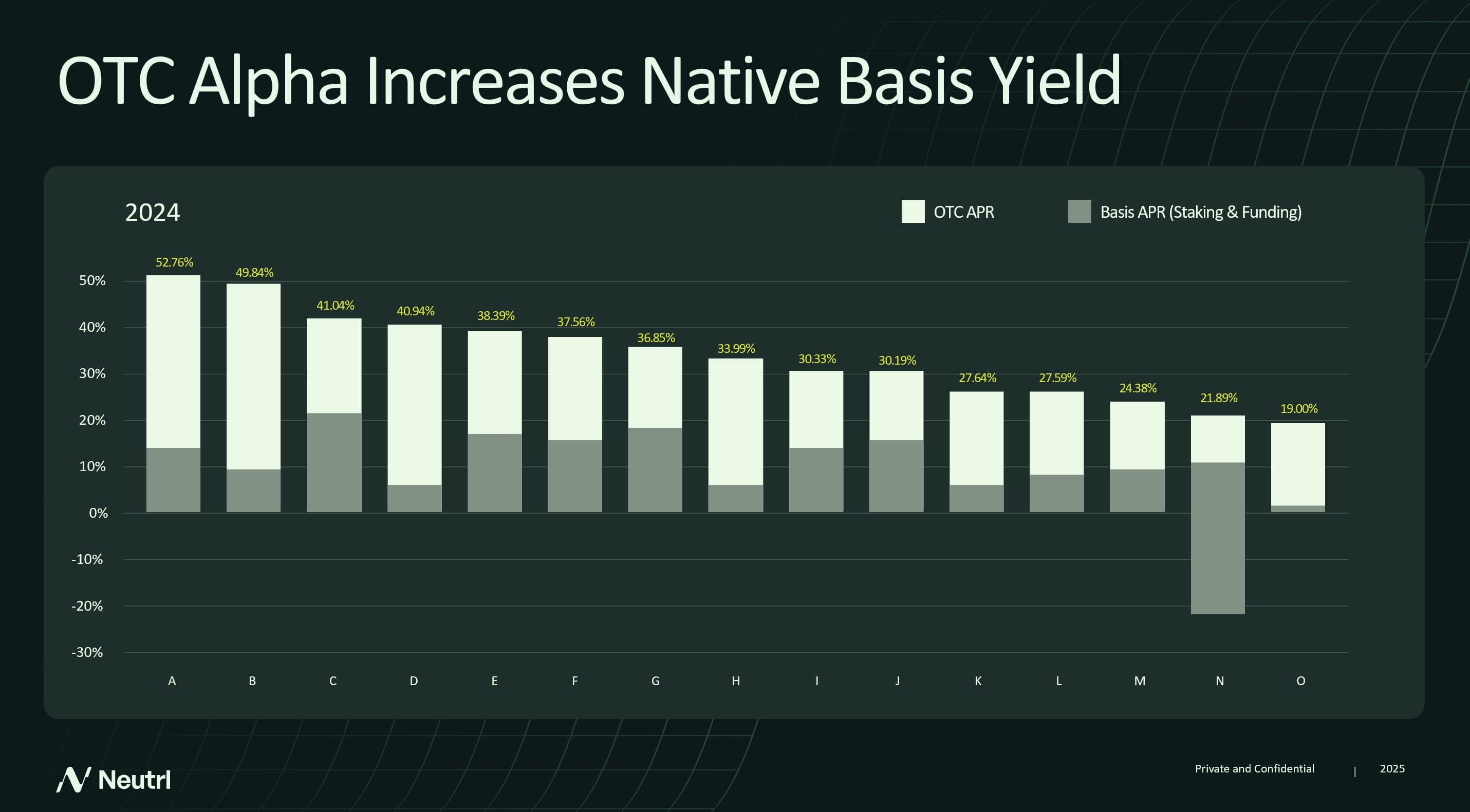
By combining OTC arbitrage with basis yield, Neutrl unlocks annualised returns in the range of 30 to 50% APR, even during volatile or low-liquidity market conditions.
Neutrl earns yield by sourcing tokens OTC at a discount and immediately hedging the exposure using perpetual futures. This locks in a fixed, market-neutral return for holders of sNUSD. There are no directional bets. No dependency on emissions or borrowing demand. Just execution-based yield.
The protocol sources OTC tokens and SAFTs directly from foundations and early investors who are seeking structured liquidity. This is not a negative signal. Foundations often sell to extend runway, fund hiring, or finance ecosystem development. Early investors typically recycle capital back into the broader crypto economy.
Once the discounted assets are secured, Neutrl opens short perpetual positions to hedge the price exposure. This is not discretionary hedging. It is systematic, designed to ensure the discount is captured as fixed return regardless of price movement or unlock timeline.
Unlocking Private Markets On-chain
These OTC deals are often inaccessible to the public. They are negotiated privately and typically allocated to large crypto funds, market makers, or high-net-worth individuals.
Neutrl unlocks them by pooling capital from the community. The protocol acts as an execution layer, enabling users to participate in structured yield strategies that would otherwise remain out of reach.
OTC vs Basis Arbitrage
Basis arbitrage is the oldest delta-neutral trade in crypto. It involves capturing funding rate dislocations between spot and perpetual futures markets. It is liquid but variable, depending on market structure and funding conditions.
OTC arbitrage is less liquid, but often produces higher and more stable returns. The yield is driven by token discounts, not by funding volatility.
Neutrl combines both strategies in a blended yield model. Basis arbitrage provides liquidity and flexibility, while OTC arbitrage delivers fixed, higher-margin returns over longer durations.
How OTC Deals are Sourced
OTC Arbitrage - Crypto’s Best Kept Yield Secret
Neutrl accesses OTC deal flow through a mix of industry relationships, direct outreach to token foundations and early investors, and trusted OTC brokers supported by institutional custody partners.
The protocol’s advantage lies in its ability to consistently source high-quality opportunities, apply rigorous due diligence, and execute with a level of risk management typically reserved for professional trading firms. In a market where poor execution can significantly reduce returns, Neutrl prioritises precision, consistency, and operational discipline across every stage of the process.
Managing Risk at Every Level
Neutrl’s risk framework is foundational to its strategy and execution. Counterparty risk is managed through smart contract vesting or institutional-grade escrow with providers such as BitGo, Anchorage, and CEFFU, ensuring every deal includes clearly defined settlement mechanics. Exchange risk is mitigated using off-exchange settlement (OES), which keeps assets secured and minimises exposure to centralised venues. Liquidity risk is addressed by maintaining capital buffers sourced from liquid basis arbitrage positions and stable collateral pools. Hedging risk is controlled through perpetual liquidity analysis, careful position sizing, and automated execution systems.
Neutrl does not rely on informal agreements. There are no handshakes. Every transaction is secured either onchain or under enforceable contractual terms.
Addressing a Common Misconception
A common misconception is that shorting a token after acquiring it OTC is inherently bearish or predatory. This is not the case. Neutrl hedges to neutralise price exposure, not to speculate on downside.
Neutrl’s goal is to preserve yield, manage volatility, and ensure that unlock events unfold with minimal market disruption. In practice, most token unlocks are followed by immediate sell pressure. By hedging these positions, Neutrl helps smooth the distribution process and mitigate sharp price movements, creating a more stable and predictable environment for all participants.
Hedging Helps the Broader Market
Neutrl’s hedging approach delivers clear benefits to the broader market by reducing sudden spot selling into thin liquidity and helping to maintain balanced perpetual funding rates across venues. It increases open interest and deepens perp liquidity, creating more favourable conditions for long-side participants.
These effects contribute to healthier price discovery, reduced volatility, and a more resilient market structure, particularly during token unlock events. Both investors and token projects benefit from this added stability and predictability.
Benefits or Token Teams
For project teams, working with a hedged OTC participant like Neutrl offers several key advantages. Token flows are predictable and structured, reducing uncertainty around liquidity events. Volatility during unlock periods is minimised through systematic hedging, which protects both the protocol and the market.
Most importantly, Neutrl provides long-term alignment as a professional counterparty. It does not flip tokens for short-term gain. Instead, it manages exposure responsibly, preserves value, and operates with full transparency.
Benefits for Investors
For users, Neutrl offers access to high-quality OTC opportunities paired with risk-managed, delta-neutral execution. The result is a stable, uncorrelated yield stream backed by real trading activity rather than speculative narratives or inflationary incentives. This is real yield, generated through structured deals, professional risk controls, and full onchain transparency. It is designed to be sustainable, measurable, and resilient across market conditions.
Looking Ahead
Neutrl continues to build the infrastructure for sustainable, market-neutral yield in crypto. With the dApp in development and expanded dashboards, documentation, and strategy breakdowns on the way, the focus remains clear: unlock institutional-grade yield through structured execution, transparent risk management, and composable onchain access.